> ## Documentation Index
> Fetch the complete documentation index at: https://docs.runchat.com/llms.txt
> Use this file to discover all available pages before exploring further.
# Agents
> See the agents running across your workflows and stop them, and manage scheduled agents from the Runchat dashboard: the week ahead, run history, intervals, and failed runs.
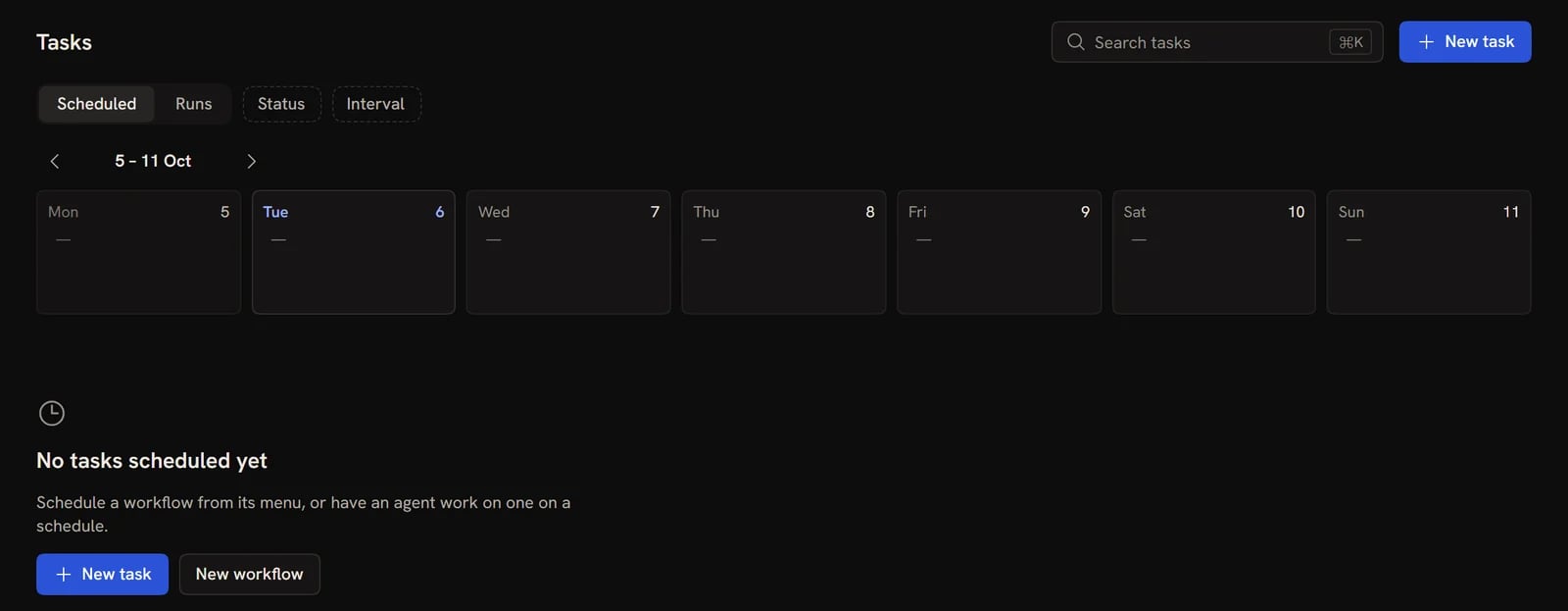
The Agents page in the [Runchat Dashboard](https://runchat.com/dashboard/agents) shows the agents working for you. At the top are the agents running right now, on any workflow. Below are your scheduled agents, with the week ahead and the run history.
A scheduled agent runs on an interval. It can simply run a workflow as it is, or it can run a prompt: instructions the agent carries out on a workflow each time, such as checking the latest outputs and summarising what changed.
To schedule a workflow, see [Scheduling agents](/concepts/automations/schedule-tasks).
 ## Running agents
With [agent teams](/concepts/agents/chat) turned on, an agent keeps working after you close its workflow, so it can be running without a tab open. The **Running** section lists every agent at work, grouped by workflow, with what it is doing and the credits it has used so far.
* Click **Stop** to stop one agent. The work it has done so far stays on the canvas and in the chat.
* Click **Stop all** to stop every agent on that workflow.
* Click the workflow name to open it and pick the chat back up.
The list refreshes by itself while anything is running. A teammate stopped here stays stopped until you message it again.
## Scheduled and Runs
A toggle at the top switches between two views:
* **Scheduled**: every scheduled agent, next run first
* **Runs**: the run history, grouped by day, newest first. Click **Load older runs** to go further back.
Use **Search agents** to find a scheduled agent by name, and the **Status** (**Succeeded**, **Failed**) and **Interval** (**Hourly**, **Daily**, **Weekly**, **Monthly**, **Paused**) filters to narrow either view.
## Week strip
The week strip above the list shows one week at a time. Each day lists how many runs **ran** or **failed**, and which agents are scheduled. Use the arrows to move between weeks, and **This week** to jump back.
Click a day to show only that day's agents or runs. Click it again, or click **Clear day**, to see everything.
## Scheduled agents
Each row shows the agent's name, its interval, when it runs next, and a **Last ok** or **Failed** badge for its most recent run. Agents that run a prompt carry a **Prompt** badge; the rest run their workflow as it is.
Click an agent that runs a workflow to open the workflow. Click one that runs a prompt to edit it. Open a row's **…** menu, or right-click it, for:
* **Edit** (agents that run a prompt only): change the agent's settings
* **Run now**: run the agent immediately, without waiting for the next interval. Useful for checking a schedule works.
* **Change interval**: switch between **Hourly**, **Daily**, **Weekly** and **Monthly**
* **Pause**: stop the schedule without deleting it. Paused agents show **Paused** in place of the next run. Pick an interval under **Change interval** to resume.
* **Open workflow**
* **Delete…**: remove the schedule and its run history. The workflow itself is kept.
## Runs
Each run shows the workflow name, when it ran, how long it took and the credits it used. Failed runs are marked **Failed** and show the first line of the error.
Click a run to open the workflow with that run loaded, so you can inspect what happened.
## Agents that run a prompt
Scheduling a workflow gives you an agent that runs it as it is. To have the [agent](/concepts/agents/chat) do more than that, give it a prompt. For example: check the latest outputs every morning and summarise what changed.
Click **New agent** to open the **New agent** dialog:
* **Agent name**
* **Workflow**: the workflow the agent works on. You can also create a new one from here.
* **Schedule**: how often the agent runs
* **Instructions**: the prompt, which is what the agent should do each time it runs
* **Model**: the agent's model
* **Permissions**: **View only**, **Edit canvas**, or **Edit and run**. Pick **Edit and run** if the agent needs to run nodes.
* **Context tools**: installed tools (workflows you've added with **Add to my nodes**) the agent should have on hand
* **Reasoning effort**: from **Off** to **Max**
* **Max budget per run**: a credit cap for each run, or **No limit**
Click **Create agent**. It appears in the **Scheduled** list with a **Prompt** badge.
## Next steps
* [Scheduling agents](/concepts/automations/schedule-tasks): schedule a workflow from the editor or dashboard
* [Webhooks](/concepts/automations/webhooks): trigger workflows from external events instead of on a fixed schedule
* [Dashboard](/concepts/dashboard/overview): the rest of the dashboard
This documentation is built and hosted on [Mintlify](https://mintlify.com), a developer documentation platform.
## Running agents
With [agent teams](/concepts/agents/chat) turned on, an agent keeps working after you close its workflow, so it can be running without a tab open. The **Running** section lists every agent at work, grouped by workflow, with what it is doing and the credits it has used so far.
* Click **Stop** to stop one agent. The work it has done so far stays on the canvas and in the chat.
* Click **Stop all** to stop every agent on that workflow.
* Click the workflow name to open it and pick the chat back up.
The list refreshes by itself while anything is running. A teammate stopped here stays stopped until you message it again.
## Scheduled and Runs
A toggle at the top switches between two views:
* **Scheduled**: every scheduled agent, next run first
* **Runs**: the run history, grouped by day, newest first. Click **Load older runs** to go further back.
Use **Search agents** to find a scheduled agent by name, and the **Status** (**Succeeded**, **Failed**) and **Interval** (**Hourly**, **Daily**, **Weekly**, **Monthly**, **Paused**) filters to narrow either view.
## Week strip
The week strip above the list shows one week at a time. Each day lists how many runs **ran** or **failed**, and which agents are scheduled. Use the arrows to move between weeks, and **This week** to jump back.
Click a day to show only that day's agents or runs. Click it again, or click **Clear day**, to see everything.
## Scheduled agents
Each row shows the agent's name, its interval, when it runs next, and a **Last ok** or **Failed** badge for its most recent run. Agents that run a prompt carry a **Prompt** badge; the rest run their workflow as it is.
Click an agent that runs a workflow to open the workflow. Click one that runs a prompt to edit it. Open a row's **…** menu, or right-click it, for:
* **Edit** (agents that run a prompt only): change the agent's settings
* **Run now**: run the agent immediately, without waiting for the next interval. Useful for checking a schedule works.
* **Change interval**: switch between **Hourly**, **Daily**, **Weekly** and **Monthly**
* **Pause**: stop the schedule without deleting it. Paused agents show **Paused** in place of the next run. Pick an interval under **Change interval** to resume.
* **Open workflow**
* **Delete…**: remove the schedule and its run history. The workflow itself is kept.
## Runs
Each run shows the workflow name, when it ran, how long it took and the credits it used. Failed runs are marked **Failed** and show the first line of the error.
Click a run to open the workflow with that run loaded, so you can inspect what happened.
## Agents that run a prompt
Scheduling a workflow gives you an agent that runs it as it is. To have the [agent](/concepts/agents/chat) do more than that, give it a prompt. For example: check the latest outputs every morning and summarise what changed.
Click **New agent** to open the **New agent** dialog:
* **Agent name**
* **Workflow**: the workflow the agent works on. You can also create a new one from here.
* **Schedule**: how often the agent runs
* **Instructions**: the prompt, which is what the agent should do each time it runs
* **Model**: the agent's model
* **Permissions**: **View only**, **Edit canvas**, or **Edit and run**. Pick **Edit and run** if the agent needs to run nodes.
* **Context tools**: installed tools (workflows you've added with **Add to my nodes**) the agent should have on hand
* **Reasoning effort**: from **Off** to **Max**
* **Max budget per run**: a credit cap for each run, or **No limit**
Click **Create agent**. It appears in the **Scheduled** list with a **Prompt** badge.
## Next steps
* [Scheduling agents](/concepts/automations/schedule-tasks): schedule a workflow from the editor or dashboard
* [Webhooks](/concepts/automations/webhooks): trigger workflows from external events instead of on a fixed schedule
* [Dashboard](/concepts/dashboard/overview): the rest of the dashboard
This documentation is built and hosted on [Mintlify](https://mintlify.com), a developer documentation platform.