

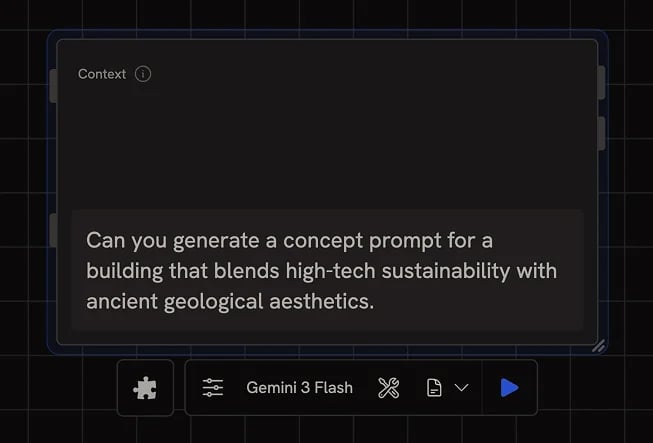
The Agent node runs once per execution and isn’t conversational. For an
interactive agent that you can chat with, use Chat
instead.
Inputs
The Agent node has four inputs:- Context: messages, images, PDFs, or other documents the model should read before responding. Equivalent to the conversation history in a chat. Common uses include feeding in input from an App, wiring previous Agent outputs back in to continue a conversation, or attaching reference images.
- Prompt: what you want the agent to do this turn. Within a workflow, prompts should describe a task the agent can complete in one turn. If you need follow-up questions, use Chat.
- Instruction (hidden by default): a system message describing how the agent should behave. Reveal it from the All Parameters menu when you need it.
- Format (hidden by default): a specific schema to enforce when returning data. Used to return lists or JSON objects.
Selecting a model
Click the model dropdown in the settings bar to choose a text model. The Agent node only shows installed models compatible with text and reasoning. See Models for installation.Output formats
Open the settings panel (the sliders icon in the settings bar) and pick an Output format to constrain how the agent returns its answer. Three options are available:- Markdown (default): free-form text. Most flexible, good for general responses.
- List: returns multiple items as a list. Each item becomes a separate output, so downstream nodes process them in parallel.
- Custom schema: define a JSON Schema the agent must match. Useful for generating structured data to pass to APIs, drive routing, or feed Grasshopper components.
Custom schema types
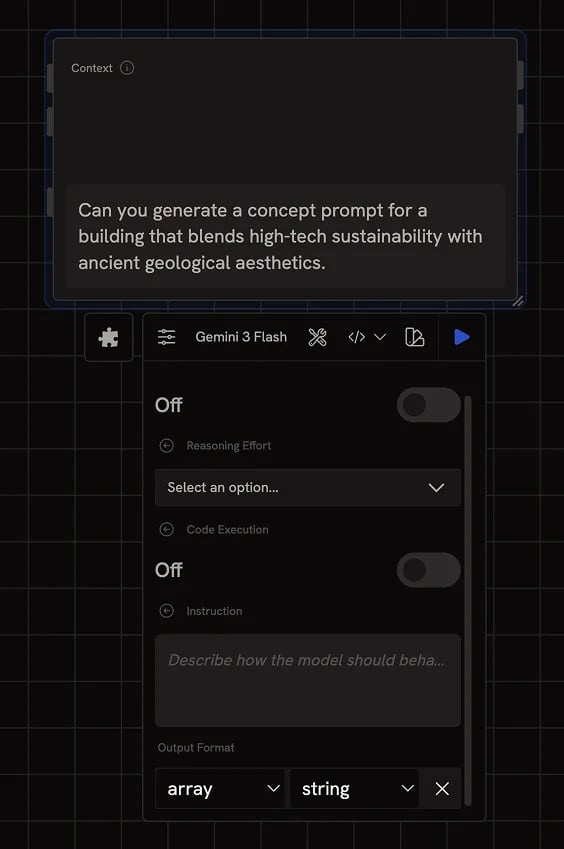
When the format is set to Custom schema, the panel shows a schema editor and a Spread Output toggle. Turn on Spread Output so each top-level key becomes its own output parameter on the node. See Parameters for the full Spread Output behaviour.
Tools
Unlike Chat, the Agent node never adds Tools automatically, you specify them explicitly. Click the Tools button (wrench icon) in the settings bar to attach Tools (your own published workflows or default Tools like search) to this Agent. The agent will call attached Tools as needed during a single run. For example, an agent prompted to “design a website for a new brand” with search and image-generation tools attached might:- Use search to research the brand and similar companies
- Pull representative images from sources it finds
- Call an image-generation Tool to create new visuals in a similar style
- Return an HTML output
Tool effort
Once tools are attached, the Tool effort option in the settings panel caps how many tool calls the agent can make in a single run:- Fast: up to 3 tool calls. Good when you want the agent to use a specific tool selectively.
- Moderate (default): up to 10 tool calls.
- Max: up to 25 tool calls. For deeper research tasks.
- Custom: set any value from 1 to 50.
Generating images
Some text models can also generate or edit images (e.g. Nano Banana, GPT-Image, Gemini multimodal). When you select one of these as the Agent’s model, the settings bar adds Variations and Size controls so you can produce multiple image variants per run. The output appears alongside the text response.Next steps
- Chat: use an interactive chat agent instead of a one-shot node
- Agent Capabilities: the full set of built-in agent tools
- Agent Tools: attach published workflows as tools
- Parameters: use Spread Output to fan a structured response into multiple outputs
- Routing: drive workflow flow with boolean Agent outputs